
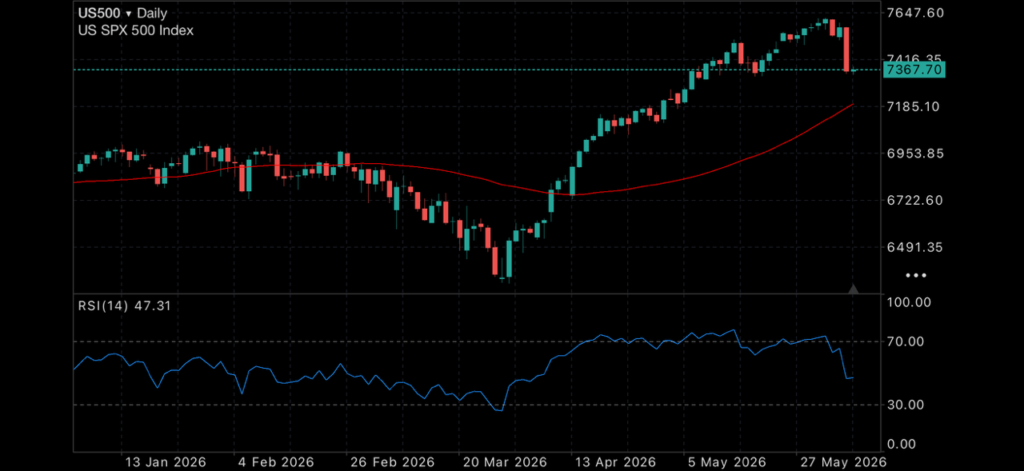
Global markets started the week on the back foot after a sharp sell-off on Wall Street late Friday erased an estimated US$500 billion in market value. The US500 fell heavily as investors reacted to escalating tensions in the Middle East, rising energy prices and growing uncertainty about the economic outlook.
US500 single day plunge shown below:
The weakness was not isolated to the United States. Australian shares also moved lower, while gold and silver retreated alongside equities. At first glance this may seem unusual, as precious metals are often viewed as defensive assets during uncertain periods. However, when volatility arrives suddenly, investors frequently sell profitable positions across multiple asset classes to raise cash, creating short-term pressure on both shares and bullion.
The catalyst appears to be a renewed deterioration in the US-Iran situation. Recent attacks and counterattacks have reignited concerns about stability in the Gulf region and the future of shipping through the Strait of Hormuz. Markets remain highly sensitive to anything that could disrupt energy supplies or place further upward pressure on inflation.
Adding to investor concerns, the Volatility Index, or VIX, surged by approximately 40% during the session. The move signals a rapid increase in market uncertainty and reflects a sudden shift from confidence towards caution. When volatility rises this quickly, investors often reduce exposure to risk assets until a clearer picture emerges.
The question now facing investors is whether this is simply a healthy correction after a strong rally, or the beginning of a broader pullback across global markets. Economic fundamentals remain reasonably supportive, but markets have become increasingly dependent on lower inflation, stable interest rates and geopolitical calm. Any disruption to those assumptions can trigger a rapid reassessment of risk.
For bullion investors, the longer-term picture remains largely unchanged. While gold and silver have softened in recent sessions, ongoing geopolitical tensions, elevated government debt levels and inflation concerns continue to provide support for precious metals as a portfolio hedge.
While the VIX regularly moves a few percent each day, a single-day jump of around 40% is unusual and typically signals a sudden shift in market sentiment. These types of moves are generally associated with unexpected events such as geopolitical conflict, financial stress, banking concerns or major economic surprises. Importantly, a large spike in the VIX does not necessarily predict a market crash. Instead, it reflects how quickly investors are repricing risk. Historically, some of the largest VIX surges have occurred during periods that later became buying opportunities, while others have marked the beginning of deeper market corrections. For investors, the key takeaway is not the VIX level itself, but the speed of the move. A 40% jump suggests markets have gone from relatively comfortable to highly uncertain in a very short period of time. Whether that uncertainty fades or grows is often what determines the next major move in shares, gold and silver.