

China may have provided the earliest warning. Its technology-heavy STAR50 index has fallen approximately 40% in less than four months, wiping around US$480 billion from market valuations. The broader Chinese sharemarket has also suffered, with the CSI300 recording its longest weekly losing streak on record. What initially appeared to be a correction in China’s overheated technology sector is now looking increasingly like part of a much wider problem.
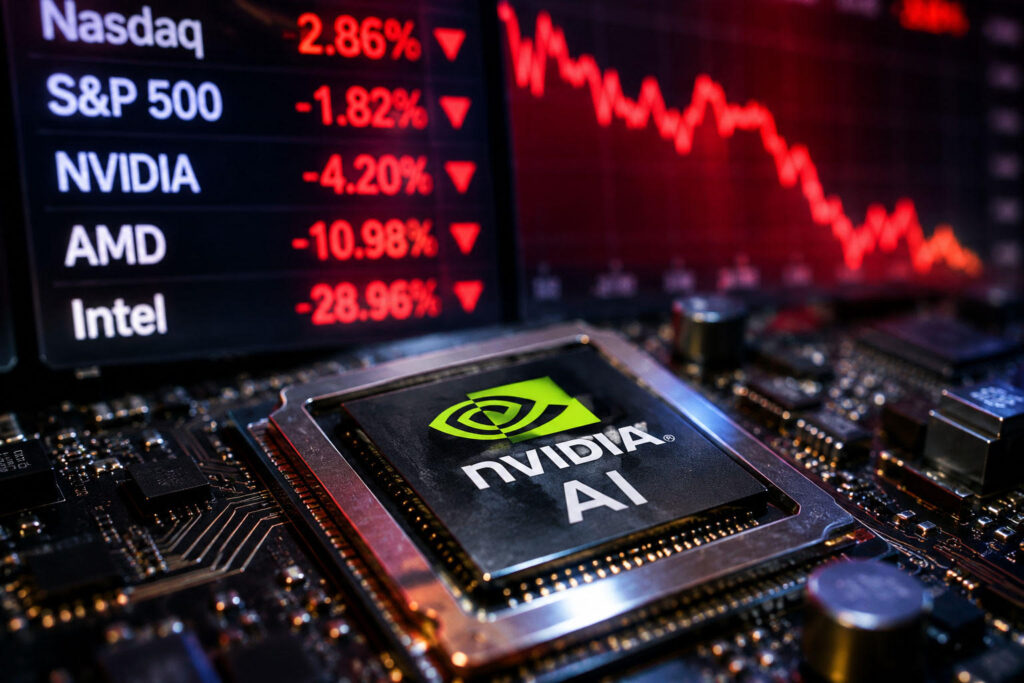
Wall Street followed with a particularly ugly finish to October. The technology-heavy Nasdaq fell 2.86% on Friday, while the S&P 500 dropped 1.82%. Intel shares plunged almost 29%, Nvidia lost 4.2%, and AMD fell nearly 11%, as investors began reassessing the enormous valuations attached to companies driving the AI revolution. Across October, more than US$2 trillion in market value was at risk of being erased from the Nasdaq 100.
The concern isn’t necessarily that artificial intelligence has failed to deliver on its promises. Far from it. AI continues to transform industries at an extraordinary pace, but the enormous amounts being invested into data centres, computer chips and infrastructure are beginning to raise uncomfortable questions about profitability. Companies are spending hundreds of billions of dollars developing technology that may take years to deliver an adequate financial return, assuming those returns materialise at all.
For Australia, the timing is particularly uncomfortable. The ASX 200 heads into Monday’s trading session facing considerable downward pressure following Wall Street’s losses, although the extent of any decline remains to be seen. Australian investors are already dealing with persistent inflation, the prospect of further interest rate increases and a weakening economic outlook. A broader international sharemarket correction would introduce another layer of uncertainty, particularly for superannuation balances and investor confidence.
There are also important differences between today’s AI boom and the dot-com bubble of the early 2000s. Many of the world’s largest technology companies are enormously profitable businesses with established customers and substantial revenues. However, even profitable companies can become dangerously overvalued when investors begin pricing in years of future growth that may prove difficult to achieve.
For gold and silver investors, the developing situation deserves attention. A sustained retreat from equities could encourage investors to seek protection in traditional safe-haven assets, potentially supporting bullion prices. However, sharp market sell-offs can initially drag precious metals lower too, as investors liquidate holdings to cover losses elsewhere. With gold already testing the psychologically important US$4,000 level, the coming sessions could prove particularly significant.
The question now is whether markets are experiencing a healthy correction after years of enthusiasm, or the beginning of something considerably more serious. China’s technology sector has already suffered substantial losses, and Wall Street is showing signs of following. While it remains too early to declare that the global AI bubble has burst, investors are clearly becoming less willing to pay extraordinary prices for promises of future profitability.
History offers an interesting lesson. The internet didn’t disappear when the dot-com bubble burst in 2000. In fact, it went on to become one of the most transformative technologies in human history. What collapsed were the unrealistic valuations investors had attached to companies expected to benefit from it.
Artificial intelligence could follow a similar path. The technology may fundamentally change the global economy while investors in some of its most celebrated companies suffer substantial losses. For bullion investors, this distinction matters because periods of excessive speculation followed by declining confidence can encourage a reassessment of risk, debt and the value of holding physical assets.
Disclosure: This article is provided for general information and educational purposes only and does not constitute financial advice. Markets can move quickly and past performance is not a reliable indicator of future results. Always conduct your own research and consider your personal circumstances before making investment decisions.