


Every major technological revolution has followed a remarkably similar path. The arrival of railroads in the 1800s promised to connect entire nations and fundamentally change commerce. Investors poured enormous sums into railway companies, sending valuations to extraordinary levels. The technology fulfilled its promise, but many of those early railway businesses failed or saw their share prices collapse once competition increased and speculative enthusiasm faded.
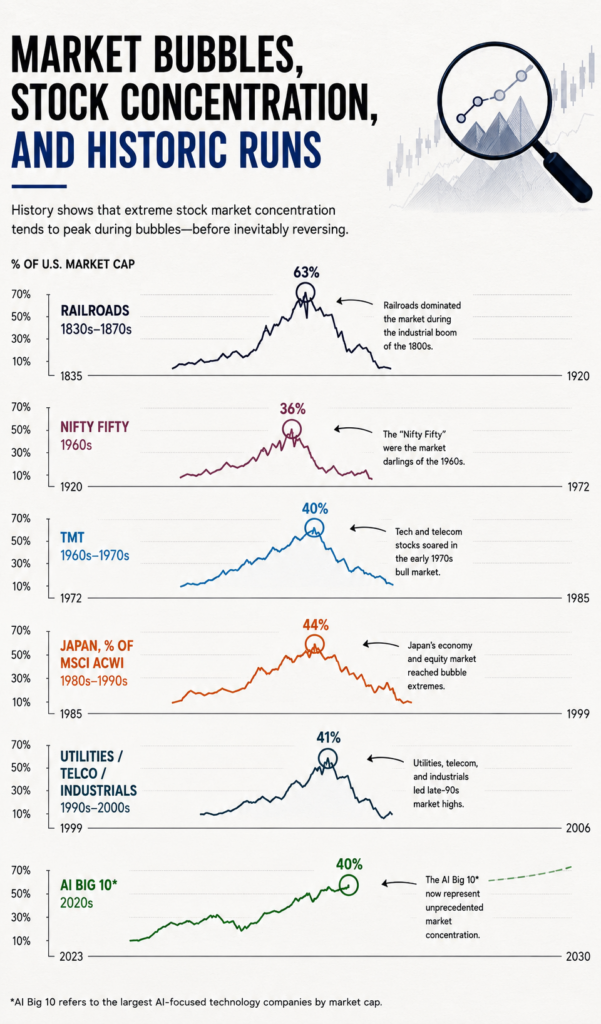
The same pattern repeated itself through telecommunications. During the telecom boom of the 1970s and, even more dramatically, the internet and telecommunications boom of the late 1990s, investors believed the world had permanently changed. In many ways they were right. The internet did transform business, communication and society. Yet despite that success, countless companies disappeared entirely, while many surviving businesses saw their share prices fall 70–90% before eventually recovering years later.
History suggests that innovation usually survives, while excessive valuations often do not.
That doesn’t mean artificial intelligence is destined to fail. Quite the opposite. AI is already improving productivity, reducing costs and opening entirely new markets. The question investors continue to ask is whether today’s prices already reflect many years of future growth. If history is any guide, the technology itself may prove revolutionary while market valuations periodically return to more sustainable levels before the next phase of growth begins.
Meanwhile, commodity markets have enjoyed a relatively quieter session. Oil prices edged modestly higher as traders continued monitoring geopolitical developments and global demand expectations. Gold, after recovering strongly from recent oversold levels, appears to be consolidating rather than extending its gains. This period of stability is not unusual following a sharp rebound, with investors waiting for fresh economic data before committing to the next move.
Attention now turns squarely to next week’s US Consumer Price Index (CPI) release. Economists expect annual inflation to remain around 4.2%, a level that remains well above the comfort zone for the Federal Reserve. While monthly inflation has shown signs of moderating in recent months, a stubbornly high annual figure would reinforce concerns that interest rates may need to stay elevated for longer.
For financial markets, inflation remains one of the biggest variables. Higher inflation typically pressures borrowing costs, corporate earnings and consumer spending, while also influencing demand for defensive assets such as gold. With AI optimism continuing to support equities and inflation still refusing to fully retreat, next week’s CPI report could provide an important indication of whether today’s market confidence has solid economic foundations—or whether investors may once again be getting ahead of themselves.
Market bubbles are rarely driven by irrational ideas they’re usually driven by rational excitement taken too far.
When genuinely transformative technology emerges, investors correctly recognise that the world is changing. The difficulty lies in determining how much that future is worth today. As optimism builds, money floods into the sector, valuations accelerate, and expectations often become impossible to meet. History shows that bubbles don’t necessarily mean the technology failed. Railroads, electricity, automobiles, telecommunications and the internet all changed the world exactly as promised. What failed were many of the companies that investors believed would dominate those industries forever.
The lesson isn’t to avoid innovation. It’s to remember that even the greatest ideas can become overpriced, and markets have a long history of resetting enthusiasm before rewarding long-term value.