
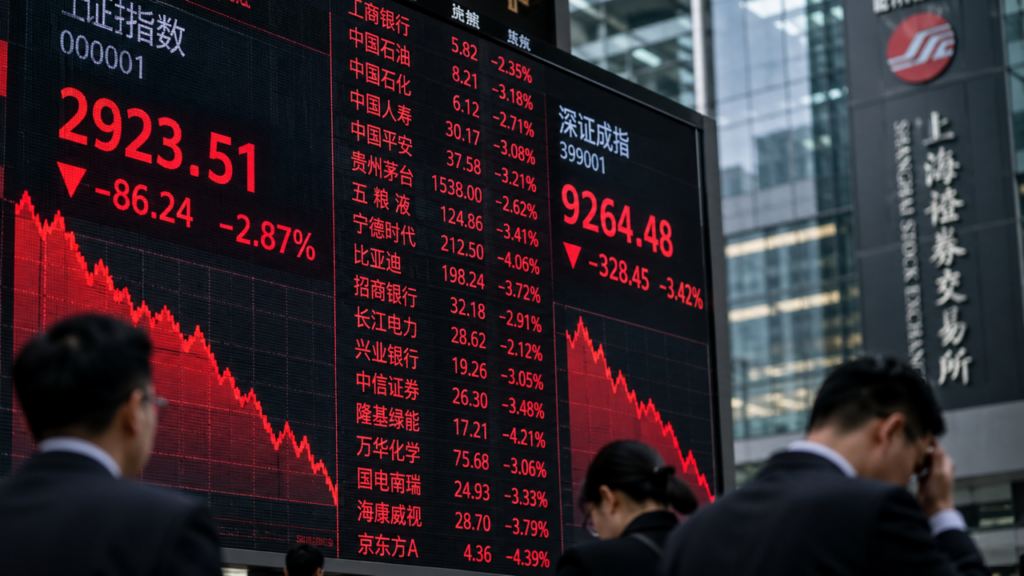
Australia has enough economic problems of its own at the moment, but developments in China could soon add another layer of pressure. China’s benchmark CSI 300 sharemarket index has now recorded 11 consecutive weeks of declines, its longest losing streak since the index was established in 2005, and is heading towards a potentially historic 12th week. With Chinese shares down around 19% from their June peak, investors are increasingly concerned about the health of the world’s second-largest economy.
For Australia, this is particularly concerning. China remains our largest trading partner and an enormous customer for Australian iron ore, coal and other resources. When China’s economy slows, demand for these commodities can weaken, putting pressure on Australian mining companies, export earnings and government tax revenue. A prolonged downturn could also weigh on the Australian dollar, making imported goods and fuel more expensive for households already struggling with the cost of living.
China’s troubles extend beyond its sharemarket. Its property sector continues to struggle, consumer spending remains subdued, and confidence in its economic recovery is proving difficult to restore. Australia’s own government forecasts already suggest iron ore export earnings could fall from A$123 billion in 2025–26 to A$107 billion this financial year. With Australian households facing elevated interest rates and stubborn inflation, a weakening Chinese economy is hardly welcome news.
Meanwhile, gold has offered investors a little encouragement after a difficult few weeks. Prices have edged higher again, trading around A$5,750–A$5,800 per ounce, as hopes grow that the US$4,000 level, equivalent to approximately A$5,690, may establish itself as a new price floor.
There is still some work to do before we can confidently call the bottom. Gold remains below its 50-day moving average, suggesting the broader recovery has yet to establish itself. However, with uncertainty growing across global sharemarkets, particularly in China, the case for holding defensive assets remains compelling.
For Australian investors, there is another interesting consideration. If China’s economic troubles place further pressure on the Australian dollar, locally priced gold could benefit even without a substantial increase in its US dollar price. With economic uncertainty building both at home and abroad, gold‘s recent resilience may be an encouraging early sign for the precious metal.
Gold is priced internationally in US dollars, meaning Australian investors are exposed to both movements in the gold price and changes in the exchange rate.
For example, if gold remains at US$4,000 per ounce and the Australian dollar trades at US$0.70, its Australian value is approximately A$5,714. If the Australian dollar falls to US$0.65, that same ounce of gold becomes worth approximately A$6,154, an increase of nearly 8% without any movement in the international gold price.
This currency relationship is one reason gold can provide Australian investors with some protection during periods of economic uncertainty, particularly when falling commodity exports place pressure on our dollar.
Disclosure: This article is provided for general information and educational purposes only and does not constitute financial advice. Markets can move quickly and past performance is not a reliable indicator of future results. Always conduct your own research and consider your personal circumstances before making investment decisions.