

Australian households may not need another chart to tell them that money is becoming tighter, but the latest comparison with other developed economies shows just how far Australia has fallen behind.
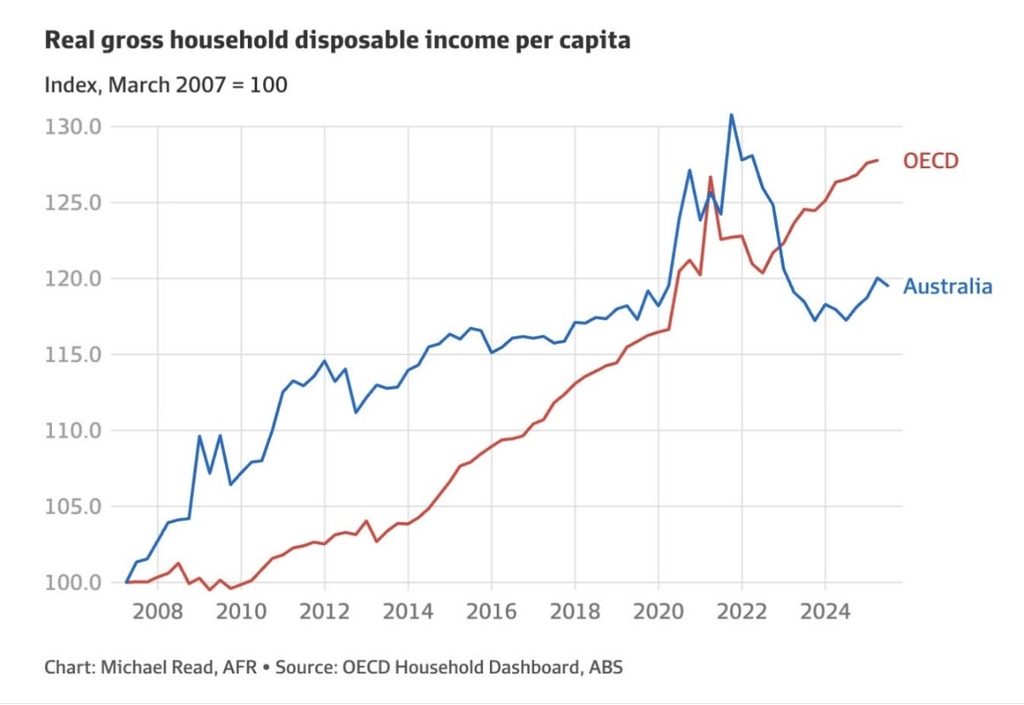
The chart tracks real gross household disposable income per person. In simple terms, this is the money households have available after taxes, adjusted for inflation and population growth. It gives us a better idea of whether the average Australian is genuinely becoming better off, rather than simply earning more dollars that buy less.
Australia is compared with the OECD, the Organisation for Economic Co-operation and Development. The OECD is a group of predominantly developed economies, including countries such as Australia, the United States, United Kingdom, Canada, Japan and much of Europe. Its data is commonly used to compare economic performance and living standards between countries.
The chart sets March 2007 at 100. Australia initially performed strongly and remained comfortably ahead of the OECD average for more than a decade. That changed sharply after 2021. Australian household disposable income per person fell from an index reading above 130 to around 120, while the OECD average continued rising towards 128.
Importantly, this does not mean the average Australian household has less disposable income than every other OECD household. It shows that income growth in Australia has gone backwards compared with its own earlier position, while the wider OECD average has continued to improve.
Higher mortgage repayments, rising taxes, inflation and weak growth in wages after inflation have all contributed. Australia may have avoided a traditional recession, but many households have experienced something that feels remarkably similar. Their income might be higher on paper, yet the amount left after paying the mortgage, tax and everyday bills has gone backwards.
This also creates another difficult problem for the Reserve Bank. Further interest rate rises may help slow inflation, but they would also remove more money from households already falling behind. Lower consumer spending then places additional pressure on Australian businesses, employment and the wider economy.
Gold and silver also gave back part of their strong weekly gains during Friday’s trading. Gold fell by more than 3% in US dollar terms, while silver dropped by around 3.5%, taking some of the shine off an otherwise encouraging recovery.
The pullback does not automatically end the improving trend. Gold is still in a stronger position against its 50-day moving average than it was earlier in August. The next test will be whether that support holds and whether the Relative Strength Index, or RSI, for gold and silver can remain above 50. If both indicators hold, the late-week decline may prove to be a pause after a rapid rise. If they weaken further, the recovery may need more time before attempting its next move higher.
Disposable income is the money households have available after paying income taxes and receiving government benefits. When economists describe it as “real”, they have adjusted the figure for inflation so it reflects what that money can actually buy.
The “per capita” measurement then divides the result across the population. This matters in Australia because total economic growth can look healthy while rapid population growth leaves less progress for each person.
The chart is also an index, with March 2007 set at 100. An Australian reading near 120 means real household disposable income per person is approximately 20% above that starting point. The OECD reading near 128 represents growth of approximately 28% across the same period.
It does not compare the actual dollar incomes of households in different countries. Instead, it shows how household purchasing power has changed in each market since 2007. On that measure, Australia built an early lead but has since surrendered much of it.
Disclaimer: This article is general information only and does not constitute personal financial advice. Precious metal prices can rise or fall, and past performance does not guarantee future results. Readers should consider their own circumstances, conduct independent research and seek professional advice before making an investment decision.