


It is a strange about-face. A business may no longer be able to add 1.5% to cover the cost of accepting a card, yet it can display the higher price and then take 1.5% off when a customer chooses a cheaper way to pay.
The card-processing cost itself has not disappeared. It will still be paid by the business, which means it will most likely be absorbed into margins, built into advertised prices or avoided by encouraging customers to use another payment method. Australians may stop seeing surcharges at the checkout, but there is every chance the same cost quietly finds its way into the price before they get there.
The maths behind repeated transaction fees is also more interesting than it first appears. If the same $100 continually moved between merchants and 1.5% was deducted every time it was processed, approximately $86 would remain with those merchants after ten transactions. After 50 transactions, less than $47 would remain.
The Impact of Processing Costs
At a 1.5% processing cost:
- After 10 transactions: $85.97 remains in the merchant chain
- After 25 transactions: $68.53 remains in the merchant chain
- After 50 transactions: $46.97 remains in the merchant chain
- After 100 transactions: $22.06 remains in the merchant chain
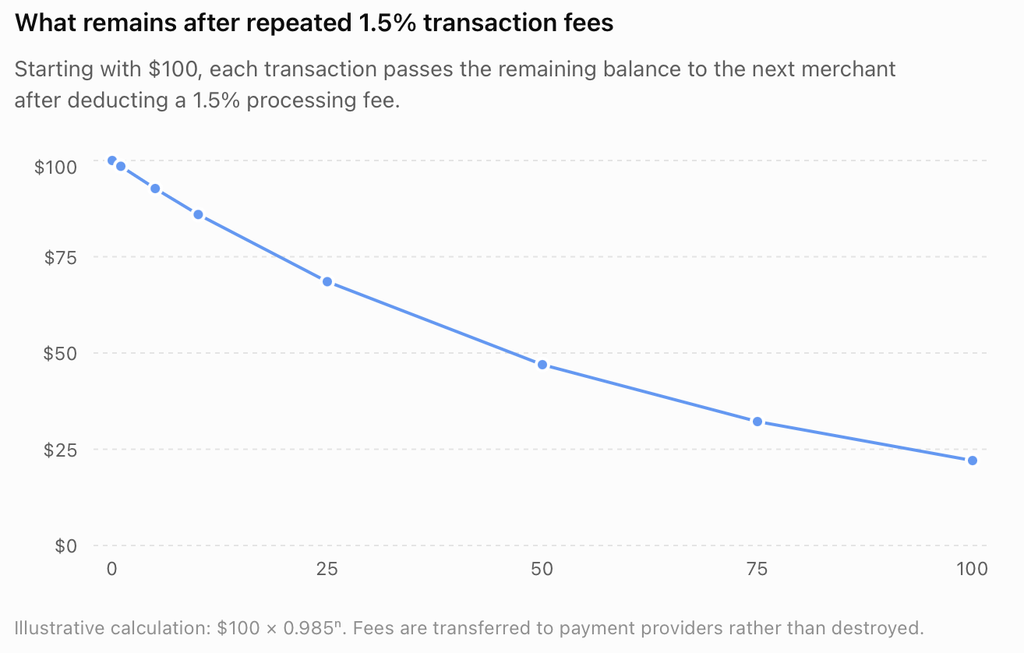
The other money has not disappeared, of course. It has moved to the banks, card networks and payment providers responsible for processing each transaction. However, within the chain of businesses buying and selling from one another, the original amount has been steadily reduced.
This is not inflation in the strict economic sense, but it does add another cost to doing business. When enough businesses recover that cost through higher prices, it becomes one more small pressure pushing in the same direction as rent, wages, insurance, freight and energy.
Unfortunately, energy is again becoming the larger concern. Oil finished the week around US$100 a barrel, while the shutdown of Saudi Arabia’s critical East-West pipeline has placed additional pressure on already restricted global supplies. The pipeline had been moving around four million barrels per day and had become particularly important while shipping through the Strait of Hormuz remained heavily disrupted.
For Australia, higher oil prices feed into far more than the number displayed at the petrol station. Freight, food, aviation, construction and manufacturing all become more expensive, making inflation harder to contain and potentially pushing any meaningful interest-rate relief further into the distance.
Gold and silver now enter the week with their 50-day moving averages applying pressure. If prices slip below these levels, it could signal further short-term weakness. However, with oil supplies tightening, inflation risks building and global markets already looking unsettled, there is also a reasonable case for bullion to find support and begin moving higher.
The week ahead will show whether technical pressure wins out or whether another burst of economic uncertainty gives gold and silver the lift they have been waiting for.
From 1 October, most Australian businesses will no longer be able to add a separate surcharge when customers use Visa, Mastercard, American Express or eftpos cards. The change should make advertised prices easier to understand, but businesses will continue paying fees whenever those cards are used.
Those costs will need to be recovered somewhere. Some businesses may accept a slightly smaller margin, while others could increase their general prices so every customer contributes towards the cost, regardless of how they pay.
The unusual part is that businesses can still offer a clearly disclosed discount for cash, PayID or bank transfers. This could effectively produce the same difference between payment methods, only with the card price shown as the standard price and the cheaper payment offered as a discount.
For consumers, the change may make checkout pricing clearer. For businesses, it creates a new decision about whether to absorb the cost, spread it across every sale or actively reward customers for choosing a less expensive way to pay.
This information is general in nature and does not constitute financial advice. Precious-metal and financial markets can move quickly, so consider your circumstances and conduct your own research before making an investment decision.