


Australia’s financial markets are sending some uncomfortable signals, with both the ASX200 and Australian dollar trading below their respective 50-day moving averages (50MDA). While neither development necessarily signals a major correction, the fact that both are occurring together, particularly following the Reserve Bank’s latest interest rate increase, raises questions about confidence in the Australian economy.
The ASX200 is currently sitting around 8,759 points, having struggled to regain the momentum that pushed the index above 9,200 earlier this year. More concerning is its position below the 50MDA, represented by the red line in today’s chart. This technical indicator is commonly used to assess medium-term market direction, with sustained trading below it often suggesting investors are becoming increasingly cautious.
The Relative Strength Index (RSI) is currently sitting at 49.44, almost perfectly neutral. This suggests the market is neither significantly oversold nor overbought, leaving room for movement in either direction. However, with the 50MDA beginning to flatten and recent rallies failing to establish a convincing recovery, the Australian sharemarket appears to be struggling to find its next direction.
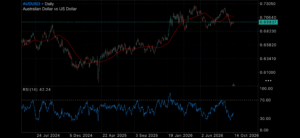
Perhaps the more interesting development is occurring with the Australian dollar. Following the Reserve Bank’s decision to lift interest rates by 0.25 percentage points in September, conventional economic thinking would suggest the Australian dollar should strengthen against the US dollar. Higher interest rates generally make a currency more attractive to international investors seeking better returns, yet the opposite appears to be happening.
The Australian dollar is currently trading around US$0.6984, below its own 50MDA, with an RSI of just 42.24. While the currency has recovered slightly from its recent lows, the broader technical picture suggests momentum remains relatively weak. This is particularly noteworthy because higher interest rates would ordinarily provide some support for a currency, yet investors appear to be looking beyond monetary policy towards the broader economic outlook.
For Australia, those concerns are not difficult to identify. Household debt remains elevated, mortgage repayments have increased, housing prices are under pressure and businesses continue to navigate higher operating costs. Meanwhile, the Reserve Bank faces the difficult task of controlling inflation without pushing an already fragile economy into a more significant downturn.
International factors also play an important role. Currency markets respond to relative interest rates, rather than simply whether one central bank has raised them. Expectations surrounding US monetary policy, global investor sentiment and demand for Australian commodities can all influence the AUD/USD exchange rate, sometimes overwhelming the immediate benefits of a domestic rate increase.
For Australian consumers, a weaker dollar creates another potential problem. Imported goods, machinery, technology and products priced in US dollars become more expensive, potentially adding further inflationary pressure at precisely the time the Reserve Bank is attempting to bring inflation under control.
For precious metals investors, the relationship is particularly interesting. Gold and silver are internationally priced in US dollars, meaning a weaker Australian dollar can support their local prices even when international bullion markets remain relatively unchanged. This currency effect can provide Australian investors with an additional layer of protection against domestic currency weakness, although movements in the underlying metal price can still outweigh that benefit.
The coming weeks will be important for both markets. A sustained recovery above their respective 50-day moving averages would help restore confidence, while continued trading below these levels could suggest investors are becoming increasingly concerned about Australia’s economic direction. With interest rates rising, housing weakening and the Australian dollar struggling to respond, the Reserve Bank may be discovering that controlling inflation is only one part of a much larger economic challenge.
Interest rates are one of the major influences on currency values, but the relationship is more complicated than it first appears.
When the RBA raises rates, Australian investments can become more attractive because they potentially offer higher returns. However, currency traders are generally more interested in what happens next than what has already occurred. If investors believe higher rates will damage economic growth, weaken corporate earnings or eventually force the RBA to reverse course, the Australian dollar can fall despite the increase.
There is another important consideration: markets often price in interest rate decisions well before they happen. If a rate increase is widely expected, its effect on the currency may already have occurred by the time the announcement is made.
Despite the RBA lifting its cash rate to 4.60%, the Australian dollar remains below its 50-day moving average, suggesting the market is weighing broader economic concerns against the benefits of higher interest rates.
For Australian investors, this is worth watching closely. A weaker dollar can increase the local cost of imports while supporting the Australian-dollar value of internationally priced assets such as gold and silver.
The important lesson is that a rising interest rate doesn’t necessarily mean a strengthening economy or currency. Sometimes it simply means the central bank is fighting a more difficult economic problem.
Disclosure: This article is provided for general information and educational purposes only and does not constitute financial advice. Markets can move quickly and past performance is not a reliable indicator of future results. Always conduct your own research and consider your personal circumstances before making investment decisions.