

Tensions around the Strait of Hormuz continue to escalate, but the latest development may prove even more significant than missiles or naval blockades. Reports emerging over the weekend suggest Iran is considering allowing limited oil tanker passage through the strait, but only if the oil cargo is traded in Chinese yuan rather than US dollars. If implemented, the move would strike directly at the financial architecture underpinning global energy trade, rather than simply disrupting shipping lanes.
The Strait of Hormuz remains one of the most critical energy choke points in the world, carrying roughly 20% of global oil supply, around 18–20 million barrels per day through the narrow passage. Control over that flow has always been strategic, but tying safe passage to currency choice would push the conflict into a new financial dimension.
For more than five decades the global oil market has been dominated by the so-called petrodollar system, which began in the early 1970s when major oil producers agreed to price crude in US dollars. That arrangement forced countries buying oil to hold USD reserves, effectively exporting demand for the US currency across the global economy. The result has been extraordinary financial leverage for the United States, supporting its bond market, currency stability and global purchasing power.
Last week we briefly discussed the possibility that central bank digital currencies (CBDCs) could eventually be used to settle large commodity purchases such as oil. China and Russia have been exploring this direction for several years through initiatives including the digital yuan, the digital ruble, and cross-border settlement projects such as mBridge, a blockchain-based system designed specifically for real-time international payments between central banks. These projects are aimed at reducing reliance on the US-dollar-dominated settlement system and allowing commodities and trade flows to be settled directly between participating countries.
A blockchain-based settlement system would introduce another capability beyond simple payment. Because transactions on distributed ledgers can include verifiable metadata, commodities such as oil shipments could theoretically include proof of route or passage tied directly to the financial settlement. In practical terms, this could allow a tanker moving through the Strait of Hormuz, or any strategic shipping lane, to cryptographically prove its journey and compliance with trade terms before payment is released, or even use cryptographic proof in transaction to allow safe passage. If the geopolitical tension around Hormuz continues to escalate, we expect much more immediate discussion this week around CBDC-based commodity settlement systems as nations look for alternatives to the traditional dollar-based trade network.
A shift away from dollar-based oil trade, even partially, could have significant implications. If a meaningful portion of global energy trade moved into alternative currencies such as the yuan, the structural demand for US dollars would weaken. Given that roughly one fifth of global oil supply moves through Hormuz, even a partial change in settlement currency could begin to erode the financial dominance the USD has enjoyed since the 1970s.
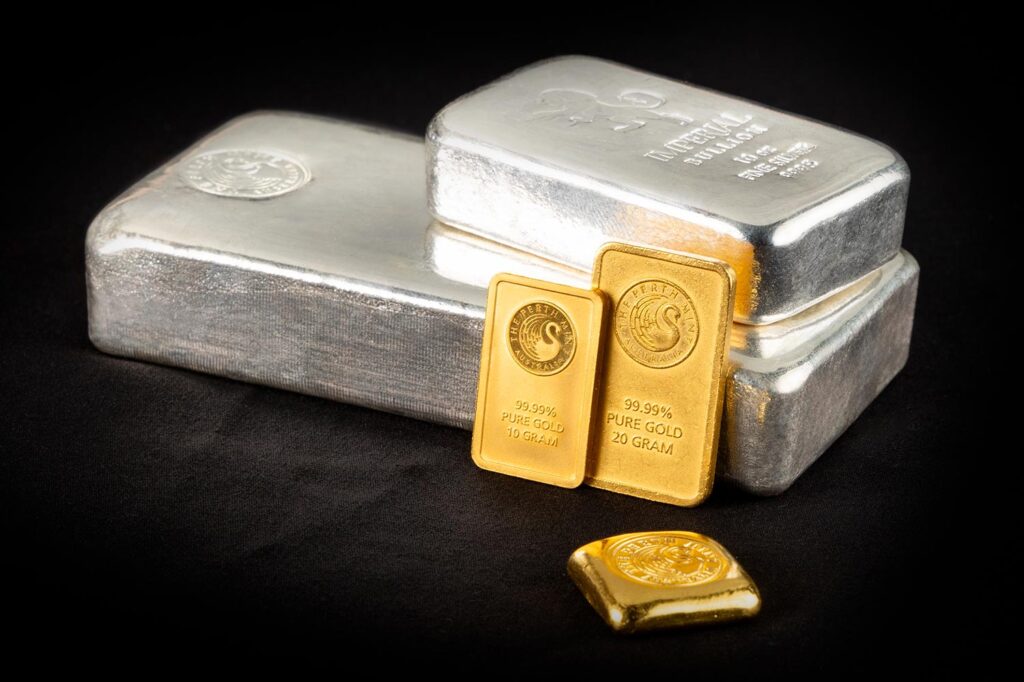
With gold and silver yet to open for the week, markets will be watching closely how capital reacts to this development. Traditionally both the US dollar and gold act as safe-haven assets during geopolitical conflict. If confidence in the dollar begins to weaken at the same time global tensions rise, bullion could find itself in a uniquely strong position as investors search for a neutral store of value outside the currency system.
Technical Indicators FOR GOLD – Weekly Projections
Daily technical indicators – SELL, leading into weekly projection of STRONG BUY
Weekly technical indicators chart.
| RSI(14) | Buy |
| STOCH(9,6) | Buy |
| STOCHRSI(14) | Oversold |
| MACD(12,26) | Buy |
| ADX(14) | Overbought |
| Williams %R | Buy |
| CCI(14) | Buy |
| ATR(14) | High Volatility |
| Highs/Lows(14) | Buy |
| Ultimate Oscillator | Neutral |
| ROC | Buy |
| Bull/Bear Power(13) | Buy |
One question that often comes up when discussing the US dollar’s dominance in global oil trade is how the issuing country actually benefits. Contrary to popular belief, the United States does not take a direct percentage or fee every time oil is traded in US dollars. Instead, the benefit comes from global demand for the currency itself. Because oil and many other commodities are priced in USD, countries around the world must hold large reserves of US dollars in order to purchase energy and conduct international trade.
This constant demand effectively allows the United States to export its currency to the world. Foreign governments, banks and companies hold trillions of dollars in reserves, treasury bonds and financial assets simply to facilitate trade. That demand lowers borrowing costs for the US government and strengthens the value of the currency. In simple terms, when your currency becomes the backbone of global trade, the rest of the world is effectively helping finance your economy by holding and using it.
If alternatives such as yuan settlement or future CBDC-based commodity payments gain traction, that structural demand for US dollars could slowly weaken. Even small shifts in global commodity settlement can have large long-term effects on currency strength, capital flows and the balance of financial power between nations.